Aerial Fencing: En Garde!
posted at 9:13 PM
|
3 comments |
 | Post a Comment
3 Comments:
Recently, two men from Pennsylvania did something that the entire Russian air force was never able to achieve during the Cold War. They got their aircraft within three miles of the National Mall in the Nation's Capitol and forced the evacuation of over 35,000 people from the Capitol, the White House and the Supreme Court.The first lady, visiting former first lady Nancy Reagan, and Vice President Dick Cheney were airlifted out by helicopter and the entire White House complex was evacuated. The President was riding mountain bikes with a high school friend at Patuxent Wildlife Research Center in suburban Maryland; and wasn't notified until after the crisis was over. And Hayden Sheaffer and Troy Martin came as close as anybody has ever come to getting shot down by missiles funded by their own tax dollars.
Hayden Sheaffer has been an FAA licensed pilot since at least the late 1960s. But he needed assistance at his originating airport in order to fuel the aircraft. Apparently, he didn't flip a lever far enough when trying to use the airport's fuel pumps. Other people had problems with the fuel pump, but it speaks to a lack of experience in flying out of that airfield. Equipped with some very dated maps, Sheaffer and Martin left Smoketown Airport in PA heading to Lumberton, NC to volunteer at the Mid-Atlantic Fly-In and Sport Aviation Convention. They took off at 10:30 a.m on Wednesday, May 11th and ended up flying at 2,500 feet directly into the Washington no-fly zone, the history books, and the questioning arms of Homeland Security.
The first alert went out when their plane was 21 miles - 17 minutes - from the city. This triggered the first line of defense -- the U.S. Customs Service, which patrols in Black Hawk helicopters and Citation jets over DC airspace. Customs agents with submachine guns are trained to shoot from the Black Hawks and have authority to use lethal force if their lives or the lives of others are endangered. I sometimes see the helicopters doing race track patterns from the balcony of my apartment building in Friendship Heights, MD. A helicopter and jet were dispatched at 11:47 a.m. from Reagan National Airport. These aircraft flew off the wing of the Cessna and tried to get their attention. But no dice.
Then two Air National Guard F-16's scrambled from Andrews Air Force Base in MD and intercepted the Cessna 152 at a range of 12 miles north of Washington. Since the stall speed of an F-16 is 278 km/h while a Cessna 152 cruises at 165 km/h, the fighter planes could not pace the slower target plane and had to fly overlapping ovals around it.
For the next 9 miles, the fighter planes made individual passes near the small plane launching flares to attract the pilots' attention. It wasn't until the third pass with flares that the pilots veered off and finally made radio contact with the swarms of aircraft, ground controllers, and federal agencies that had been trying to communicate with them. The Cessna was forced down in Frederick, MD where Maryland State Police took the two men into custody.
While no criminal charges are being pressed, the two men could still face civil action by the FAA. Fines, a letter of reprimand, or license revocation are possible repercussions for entering restricted airspace, failing to respond to communications, and failing to be properly informed of flight restrictions. Aside from the embarrassment, the likely penalty for a pilot who strays into restricted airspace is license suspension for 30 to 120 days.
Conspiracy theories abound on the web, but the transcript of CNN's Kyra Phillips interview with Lt. Col. Tim Lehmann, one of the two Air National Guard F-16 pilots, makes it pretty clear that this was an unusual case. Unusual because of the plane's occupants, who were so clueless that when officials finally made radio contact and ordered the plane to divert, the fliers refused, asserting their right to proceed on their way. Their airplane reportedly flew into restricted airspace, turned and left the airspace, and then flew back into restricted airspace. And once on the ground, the pilot reportedly told officials that his radio was not working. To me, it seems more likely that the radio was just turned off or dialed way down in volume. As with all pilot error, the problem lies between the seat and the control yoke.
Morons. The Cessna 152 is one of the smallest 4-cylinder engine airplanes in use, and has been the standard flying-school airplane for decades. It carries about 38 gallons of fuel and can fly up about 500 nautical miles before refueling. It has been the classic pilot trainer for decades because it is cheap to fly and maintain, forgiving of errors, and moves very, very slowly. When surrounded by armed aircraft waggling their wings and zooming by you while ejecting bright red flares, the proper response is to pucker your rear-end and reach for the radio very, very quickly in order to apologize very, very profusely. Anything else is an invitation to an involuntary skydiving trip.
Around the world, there are two international radio frequencies that always are kept clear of jamming and unnecessary chatter. Referred to as the "guard" channel, 121.5 VHF is the international channel for use by aircraft in distress or emergency. A related UHF frequency at 243.0 Mhz is used for emergency locator beacons. In military and large commercial aircraft, at least one of the radios is always tuned to the guard channel. Pilots monitor this frequency at a low volume level to keep an ear out for aircraft in distress. If an air traffic controller cannot raise an aircraft on the assigned frequency, they usually try 121.5 VHF next. More pertinent to this situation, fighter planes will contact their intercept targets on this frequency...
Pilots of all aircraft with the radio capability are instructed to monitor the guard frequency (121.5 MHz) while in Enhanced Class B airspace, which is the airspace in at least a 20-nautical-mile (22.7 statute mile) radius around any major airport, extending from the ground to 18,000 feet. But not all aircraft carry two radios. If you're flying in congested airspace, however, you should fork out the dough and make sure that your radio setup is as capable as possible.
In the post-9/11 world, there is a not-so-delicate balance between security restrictions and daily life. All civilian air traffic in the Washington area was shut down for a long period following September 11th. Over a period of time, flights into Reagan National resumed and local county airfields that were starting to go bankrupt from stopped operations grudgingly received permission to resume operations. The small percentage of aviators who brashly ignore the rules, however, risk not only their own skins but the fragile balance that allows general aviation to continue within the DC area.
When we fly as passengers on commercial jets, we see the pretty clouds and the itty-bitty ant lights below. What we don't see are the invisible lines that demarcate the numerous restricted zones where we are not allowed to fly. If you don't believe me, just go ahead and try to fly over Groom Lake, Nevada... It will be a very short flight.
But Area 51 is not the only restricted airspace from sea to shining sea. There are vast tracts of America that only birds, government employees, and spy satellites will ever see from overhead. Just take a gander at the map of the Washington-Baltimore area shown below. See the red zones and white zones? They have nothing to do with loading and unloading zones at the LAX terminal (pardon the bad movie reference to "Airplane").
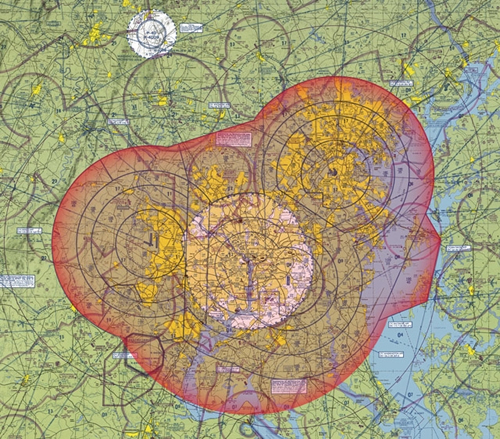
The air defense system for Washington is complex and layered. It was updated in January of 2003 to replace the active fighter patrols that had been covering the skies over the Nation's Capitol since Sept. 11, 2001 -- an extremely expensive defense plan. The current defense system includes a Flight Restricted Zone (FRZ), or no-fly zone, that bars most air traffic from a ring that extends 16 miles from the Washington Monument -- with the major exception being commercial flights to and from National Airport. A larger restricted zone, the D.C. Air Defense Identification Zone (ADIZ), extends to about 50 miles from Washington, encompasses the major airports in the greater Baltimore-Washington area, and requires pilots to identify their aircraft, activate identification beacons and stay in two-way radio contact with air controllers.
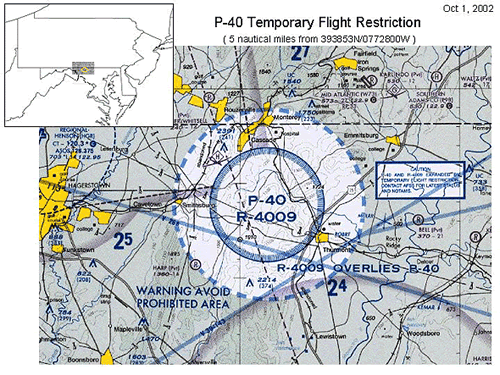
The Presidential retreat at Camp David in the Catoctin Mountains of Maryland also has a five nautical mile exclusion zone surrounding it. The AOPA (Aircraft Owners and Pilots Association) has a great multimedia explanation of the Washington ADIZ on their website at http://www.aopa.org/adiz/adiz.html.
Ironically, Sheaffer and Martin were forced down at Frederick Municipal Airport, the site of AOPA's headquarters. The 400,000-member pilot education and lobbying group says that there is "no excuse" for Sheaffer and Martin's error. Martin, the student pilot, is a member of the AOPA, which sends out hundreds of e-mails and messages a year with information on how to fly in and near restricted air spaces.
Close calls in the past have prompted changes to air defense procedures. Thousands of aircraft over Washington airspace are tagged as "of interest" every year, and hundreds have violated the no-fly zone. But very few of them trigger fighter plane scrambles and building evacuations. And every time there is a major incident, the defense plan is modified.
On June 19, 2002, another single-engine Cessna flew over the capital area before it could be intercepted, prompting the evacuation of Vice President Cheney from the White House. Military officials at the time acknowledged that aircraft could reach targets in Washington before they were intercepted by fighters on ground alert. As a result, authority for air patrols to shoot down a civilian aircraft, once limited to the president, was broadened to include the secretary of defense and his deputy, the NORAD (North American Air Defense) commander, and the commander of NORAD's continental U.S. region in Florida.
On June 9, 2004, a twin-engine Beechcraft King Air caused the evacuation of the U.S. Capitol, where thousands had gathered to await the arrival of Reagan's coffin. The cause? A broken transponder. The FAA knew about the failure because the pilot called it in while flying over Ohio. But the FAA failed to notify their military and homeland security counterparts, who monitor separate radar displays. On these scopes, an aircraft without a working transponder shows up as a radar blip with no identifying information. So an hour and a half later, the military scrambled when as an unidentified intruder entered restricted Washington airspace. Cruising at 240 miles per hour, this twin-engine plane could fly from the edge of the no-fly zone to the National Mall in four minutes. Who was this intruder? Governor Ernie Fletcher of Kentucky was the chartered passenger. As a result of this incident, two things changed. The FAA and air defense officials now use the same radar, and planes with broken transponders are no longer allowed in restricted airspace.
So what, if anything, will change after this incident? The Air Force wants to use ground-based lasers and aim them into the cockpits of planes that violate the DC no-fly zone. Alternating red and green light beams a hundred feet wide would definitely get anybody's attention. Maybe the zoomies will get their funding now.
But the most immediate fallout is political. The White House is under fire for the decision to keep the President out of the decision loop even as the White House threat level was escalated up through yellow to red. The overseas press is having a field day with this. Because while tens of thousands were sent rushing out of Federal buildings and the Supreme Court justices were herded into a basement parking garage, our Commander-in-Chief leisurely went biking for another fifty minutes.
It may be that the two pilots from Pennsylvania aren't the only ones to come out of this situation looking clueless...
I really like this turn of phrase: "They took off at 10:30 a.m on Wednesday, May 11th and ended up flying at 2,500 feet directly into the Washington no-fly zone, the history books, and questioning arms of Homeland Security."
Always interesting reading on your blog :)
Always one of my closest friends, John left college and became the true renaissance man. I became illiterate and now have trouble making my way through the comics each Sunday.
Holy cow. I didn't realize that the laser system referenced at the bottom of this post was actually scheduled for deployment for this month. The system will be operational this Saturday, 5/21.
There will be seven turrets, each housing a red and a green laser, placed around the Capital region. Visible up to 10 nautical miles away in daylight and 25 nautical miles at night, these 1.5-watt lasers will be aimed at intruding aircraft, which will receive 2 red laser pulses followed by a green pulse.
The intended message is reverse heading and start explaining yourself to air traffic control before you see fighter planes up close and personal...